
After Dad’s escape from Hong Kong he was posted to the wartime capital, Chongqing, as Assistant Military Attaché in August 1942. I had seen, in his diary entry for November 26th 1942, a few sentences about his ‘Great Thought’ – a plan to liberate the Hong Kong PoWs. The plan was worked up between Dad, Col Ride of the British Army Aid Group (BAAG) and US General Chennault’s Chief of Staff, Col Merian Cooper.
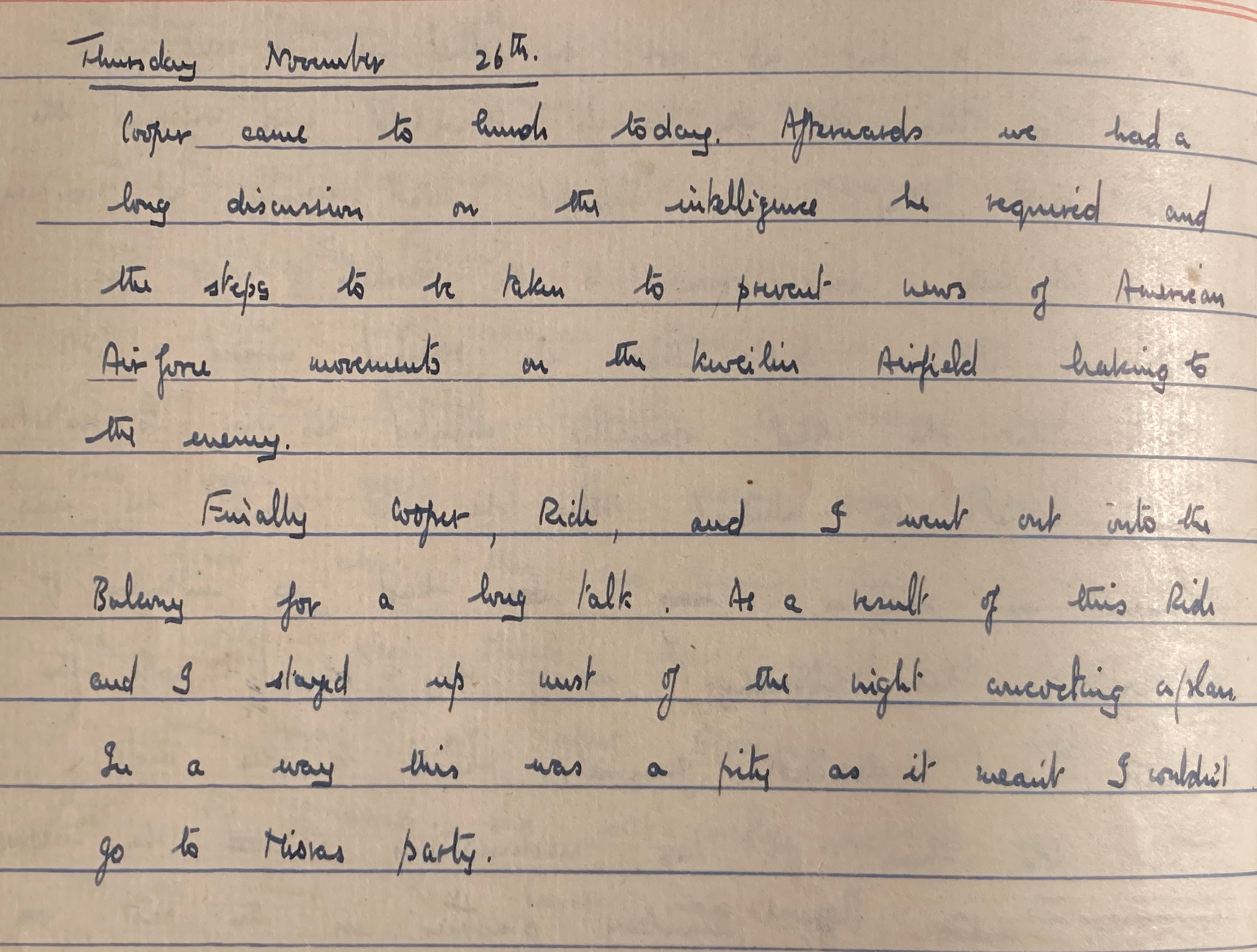
I knew that the plan had been approved at the highest level, finally agreed at the Washington Conference in May 1943 by the heads of the Allied Powers. I also knew that the plan had been scuppered by a spat between Generals Stilwell and Chennault, that resulted in resources being diverted away from the USAAF to serve the needs of the land war in Burma. Without air support the plan was impossible to execute. But I had never seen the plan or had any idea what it actually involved.
Yesterday I received details of the plan from a colleague in Hong Kong. It seems that the intention was to liberate all the PoWs held in the various camps in Kowloon and on Hong Kong Island, using British paratroopers, with Chinese BAAG and guerrilla forces and Allied air and sea support. It needed a co-ordinated, top secret, surprise attack, with air control being key to success. The Japanese believed they were entirely secure in Hong Kong and had a limited ‘occupying’ force rather than a ‘defence’ force. To succeed this would have to be a one-shot effort, as Japanese troops would be increased in response to the first raid, making it much more difficult for any subsequent raid.
Most interesting to me was an original document written by Dad in Delhi, in July 1942, before he even arrived back in China. In it he gives a strategic analysis of the liberation concept, with considerations and pros and cons given for 10 dimensions of the proposal. From my years working in marketing strategy and business planning this seems remarkably familiar! His stated object is “To get prisoners out of the internment camps at Hong Kong.” His analysis considers:
- Physical condition of prisoners
- Guarding of camps
- Reprisals and the use of force
- Japanese troops defending Hong Kong
- Terrain
- Political issues
- Forces to be employed in a raid
- Pros and Cons if we go on as we are
- Pros and Cons if we make a limited raid
- Pros and Cons if we make a full raid
It is a tragedy that the plan never came to fruition. It might have saved the lives of about 4000 European PoWs and 2500 Indian PoWs held in Hong Kong in 1943. The final ‘no go’ letter from India Command, Directorate of Military Intelligence, dated December 1943, says: “It is regretted that the resources available in the form of air transport preclude such an operation being carried out at this stage of the war against Japan. The implications of this decision are fully realised but there is no alternative.”
 Stranger In My Heart